
For women 40+ who don’t feel like themselves
You’re not losing your mind. It’s perimenopause — and nobody told you.
The 14-day guide that explains your symptoms — in plain English.

Exactly what you get
The Core Guide50+ pages · 14 daily lessons · 10 minutes a day
- What’s actually happening to your hormones — in plain English
- The 3 a.m. waking, the out-of-nowhere anxiety, the vanishing words — each mapped to its cause
- What’s normal, what isn’t, and when it’s worth a doctor’s visit
- One topic a day — understood by Day 14, not someday
- Every claim sourced: The Menopause Society, ACOG, NHS, Mayo Clinic, SWAN
The Daily Symptom Tracker12 pages · printable
- Two-week daily log — symptoms, sleep, cycle, mood, triggers
- Built to hand to a doctor: a pattern, not “I just feel off”
- Checklists so nothing gets forgotten in the appointment
- Patterns start showing by the end of week one
The Doctor Visit Playbook25+ scripted questions
- The exact questions to ask — organized by symptom
- The words that describe what you’re feeling so it lands
- What to ask about labs, referrals, and options
- Scripts for pushing back if you’re dismissed
- Ten-minute prep sheet for the night before
The Sleep, Energy & Anxiety Protocolthe 3 a.m. toolkit
- One evidence-based habit at a time — no 40-step routines
- Matched to whichever symptom is loudest for you
- What the research actually supports — and what’s wellness noise
- Built for exhausted people: smallest effective change first
Four PDFs (five with “Eat for the Shift”) · instant download · yours forever · read Day 1 tonight.
A single menopause-specialist consult typically runs $200+. This is one-time, and it makes every appointment after it count.
- The Core Guide — one 10-minute day at a time, until your symptoms finally make sense
- The Daily Symptom Tracker — turns two weeks of “feeling off” into evidence a doctor can act on
- The Doctor Visit Playbook — the exact questions and scripts for your next appointment
- The Sleep, Energy & Anxiety Protocol — the 3 a.m. toolkit, one habit at a time
50+ pages · 14 daily lessons · 12-page tracker · 25+ scripted doctor questions · 5 PDFs, yours forever
30-day money-back guarantee — if Week One doesn't explain more than months of googling did, we'll refund you in full.
Secure checkout by Shopify · Published by The Reset Series · Files delivered to your email the moment payment clears
What customers say

“I finally, and I mean FINALLY, understood what was happening.”
“This guide explained everything in a super clear way, I’m very grateful I got it when I started noticing symptoms. Stopped feeling confused and started feeling more prepared to manage the changes I was experiencing.”
Melissa, 47
“Simple and easy to follow.”
“I loved that the guide did not overwhelm me with complicated information 🙂. The tips were realistic and I could start using them in my everyday routine right away.”
Danielle, 43
“It helped me feel like myself again!”
“Before reading through the guide, I was feeling frustrated and unsure about where to begin. Going through the guide day by day gave me helpful strategies for improving my daily habits and just feel more in control. Love the work guys!”
Rachel, 50
Individual experiences vary — the Reset is education, not treatment.
Not sure how much of this is about you? Take the 2-minute check-in — nine questions, no email, and a personal map of which chapters speak to your pattern.
It usually doesn’t start with hot flashes.
It starts with being wide awake at 3 a.m. — again. With anxiety that shows up out of nowhere in your mid-forties. With reaching for a word that was there yesterday and just… isn’t. With a cycle that’s rewriting its own rules, a fuse that’s suddenly shorter, an exhaustion that sleep doesn’t fix.
And because nothing on the surface connects those things, you explain each one away. Stress. Aging. Too much coffee. Until the quiet 2 a.m. thought arrives: maybe something is really wrong with me.
Here’s what nobody put on a poster: there’s a well-documented biological explanation that connects all of it. Perimenopause — the years of hormonal transition before menopause — typically begins in your forties and can run four to eight years. Its symptoms reach far beyond hot flashes. Yet it’s barely taught in medical training, barely discussed at home, and routinely mistaken for “just stress.”
You’re not broken. You’re under-informed — because everyone kept the information quiet. That’s fixable in fourteen days.
Sound familiar?
- Waking at 3 a.m. for no reason, night after night
- New anxiety or a shorter fuse than you’ve ever had
- Words vanishing mid-sentence; walking into rooms with no idea why
- Cycles suddenly shorter, heavier, lighter, or unpredictable
- Running hot at night — or full night sweats
- Tired in a way that rest doesn’t touch
- Aching joints, heart flutters, hair and skin changes
- The creeping feeling that you’re “failing at being yourself”
If you nodded at three or more of these, the next fourteen days will be clarifying.
Grounded in
The Menopause Society · ACOG · The NHS · Mayo Clinic · the 30-year SWAN Study
Introducing
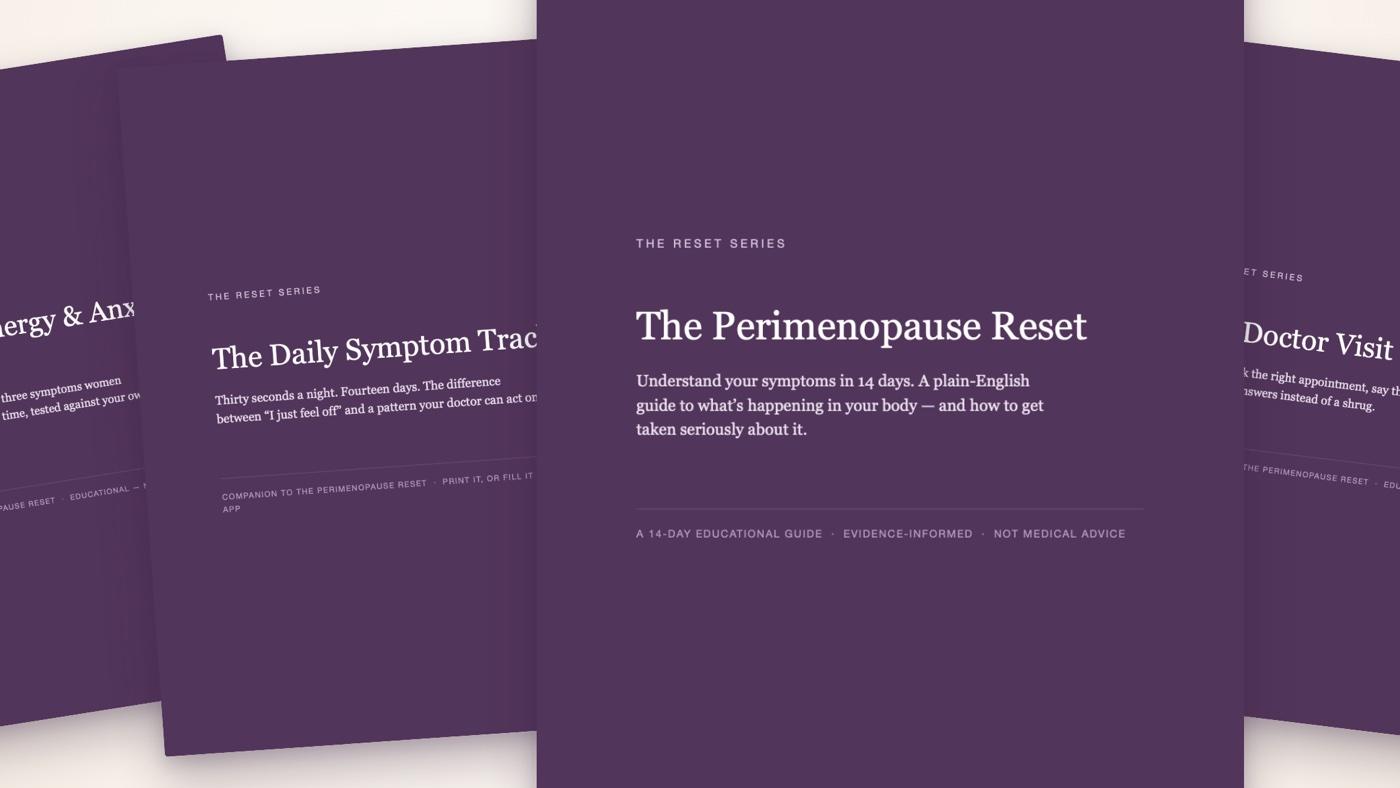
The Perimenopause Reset — understand your symptoms in 14 days
A self-paced educational system — not a lecture, not a wellness sermon, and not another “just do yoga” listicle. One short chapter a day, ten to fifteen minutes each, grounded in reputable sources: The Menopause Society, ACOG, the NHS, Mayo Clinic, and the decades-long SWAN study. By Day 14 you have something most women never get — a clear mental model of your own transition, and two weeks of organized evidence a doctor can actually act on.
Part 1 · The understanding
The Core Guide — 14 days, one topic a day
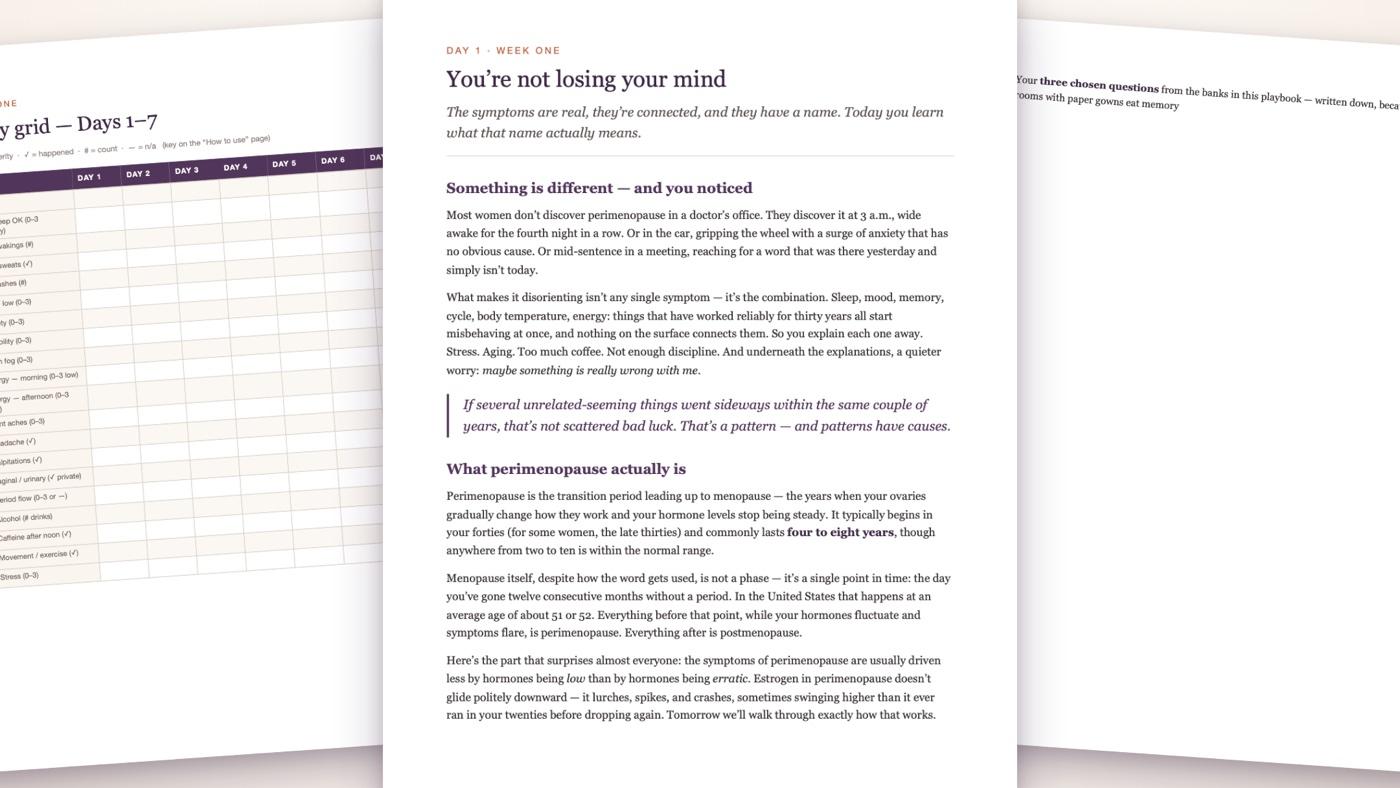
Week One explains the machinery: hormones, stages, sleep, hot flashes, mood, brain fog — in plain English that respects your intelligence. Week Two decodes the rest and turns it all into a plan. Every day ends with a ten-minute action, a myth-vs-fact, and the red flags that should never be filed under “probably just perimenopause.”
Part 2 · The evidence
The Daily Symptom Tracker
Thirty seconds a night. The difference between telling your doctor “I don’t sleep well” and showing them “I’ve woken between 2:30 and 3:30 a.m. eleven of the last fourteen nights, four with night sweats.” Clinicians act on patterns. This builds yours.
Part 3 · The conversation
The Doctor Visit Playbook
How to book the right kind of appointment (there’s a wrong kind), the exact opening sentence that sets the agenda, topic-organized question banks — including the hormone-therapy questions — and calm scripts for the moment a doctor says “that’s just aging.”
Part 4 · The daily toolkit
The Sleep, Energy & Anxiety Protocol
The habit-level companion for the three most-reported symptoms: the evening wind-down, the night-sweat bedroom setup, the 3 a.m. protocol, the energy audit, and in-the-moment tools for anxiety surges — run as one-variable-a-week experiments you score with your own tracker.
The 14-day map
Week One — what’s happening to you
- You’re not losing your mind
- Your hormones, explained like a human
- The stages: where are you?
- Why you’re awake at 3 a.m.
- Hot flashes, decoded
- Mood, anxiety, and the rage nobody warned you about
- Brain fog: your memory is (almost certainly) fine
Week Two — your symptoms, decoded — and your plan
- Periods gone strange
- The exhaustion sleep doesn’t fix
- Weight, joints, skin, heart flutters
- The symptoms nobody says out loud
- Your options: lifestyle & non-hormonal
- Hormone therapy without the fear or the hype
- Your reset plan

Why this works when googling didn’t
Googling gives you fragments. One tab says anxiety, another says thyroid, a third sells you a supplement. This gives you the connected picture, in order, from sources you can name out loud in a doctor’s office.
It arms you, not just informs you. The tracker and playbook exist because understanding without evidence still gets dismissed in a fifteen-minute appointment. Two weeks of data changes the meeting.
It’s honest about what it is. This is education. It doesn’t diagnose you, treat you, or sell you a miracle protocol. Where the evidence is strong, it says so. Where it’s thin — supplements, “hormone-balancing” diets — it says that too. That honesty is exactly what makes it useful in an exam room.
Who it’s for: you’re roughly 40–55, something has changed, and you want to actually understand it — and walk into your next appointment prepared instead of hoping. Not for you if you’re looking for a treatment plan or medical advice; those belong to a clinician who knows your history — and this guide will be the reason that conversation finally goes somewhere.
Everything in the bundle
A single menopause-specialist consult typically runs $200+. This is one-time, and it makes every appointment after it count.
- The Core Guide — one 10-minute day at a time, until your symptoms finally make sense
- The Daily Symptom Tracker — turns two weeks of “feeling off” into evidence a doctor can act on
- The Doctor Visit Playbook — the exact questions and scripts for your next appointment
- The Sleep, Energy & Anxiety Protocol — the 3 a.m. toolkit, one habit at a time
50+ pages · 14 daily lessons · 12-page tracker · 25+ scripted doctor questions · 5 PDFs, yours forever
30-day money-back guarantee — if Week One doesn't explain more than months of googling did, we'll refund you in full.
Secure checkout by Shopify · Published by The Reset Series · Files delivered to your email the moment payment clears
Not ready to buy? Start free.
Day 1 of the guide, the tracker how-to, and the Week One grid — one PDF, sent to your email. No card, no strings.
Checkout collects only your email — $0.00, no card fields.
Questions, answered honestly
Is this medical advice?
No — and that’s deliberate. The Perimenopause Reset is educational. It explains what’s happening, what the research says, and how to have a productive conversation with a qualified clinician. It never diagnoses, prescribes, or replaces your doctor; it makes your fifteen minutes with them count.
Do I need a diagnosis to start?
No. Most women in perimenopause don’t have one — that’s rather the point. The guide explains why diagnosis is usually clinical (and why a single blood test rarely settles it), and helps you gather what a clinician actually needs.
What if I’m not sure it’s perimenopause?
Then the guide earns its keep twice: it maps what the transition looks like, and it repeatedly flags the symptom patterns that deserve a medical workup instead of a shrug — including the overlaps (thyroid, iron) worth asking about.
What exactly do I get, and how?
Four PDFs (guide, tracker, playbook, protocol), emailed instantly after checkout. Read on any device; the tracker is designed for printing or filling in any PDF app. No login, no app, no subscription.
Does it push hormone therapy? Or push against it?
Neither. Day 13 explains hormone therapy the way it should have been explained years ago — the actual history, the current professional guidance, and the questions worth asking — so you can have an informed conversation. The decision belongs to you and your clinician.
How much time does it take?
Ten to fifteen minutes a day for fourteen days, plus thirty seconds each night for the tracker.
Refunds?
Thirty days, full refund, no hoops — see the guarantee above.